


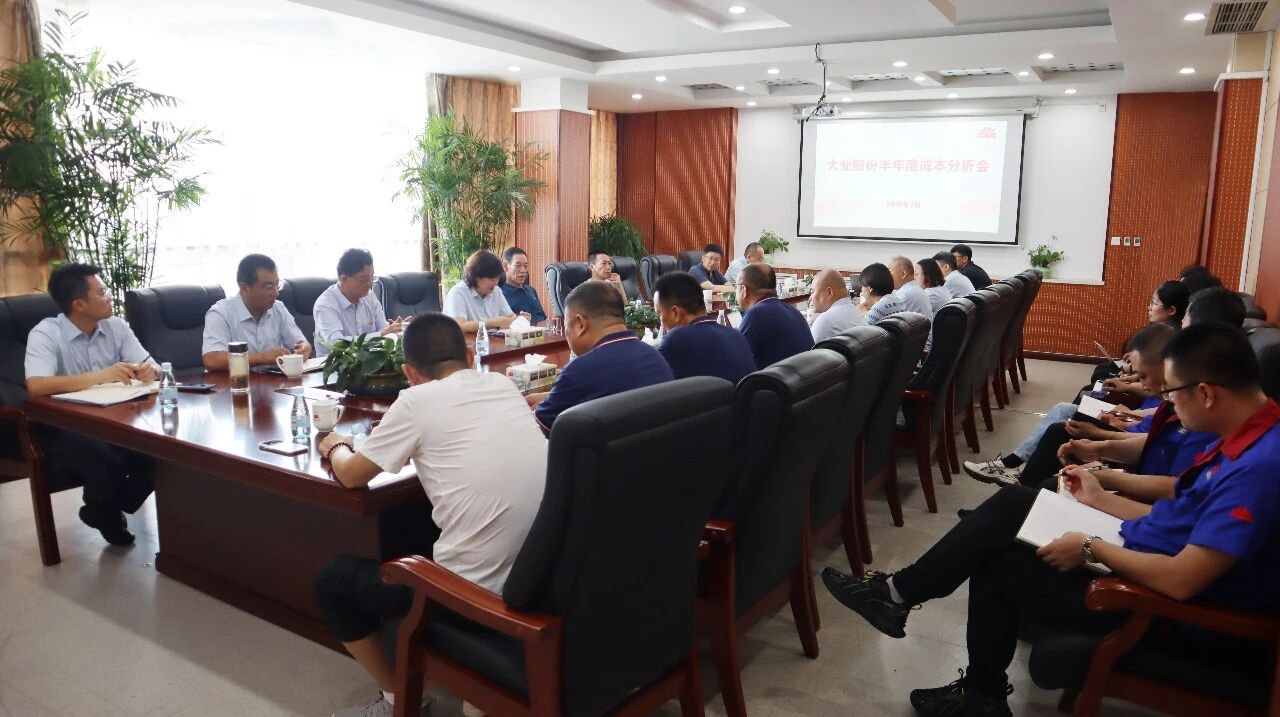
To comprehensively review the first-half cost control work, precisely analyze operational pain points and identify management shortcomings, and make coordinated arrangements for the key tasks of cost reduction, efficiency improvement, and operational breakthroughs in the second half of the year, the company held a special mid-year cost analysis meeting on July 23. The meeting comprehensively summarized the achievements and deficiencies of the first half's cost control work, focused on the difficulties and bottlenecks of cost control in all aspects of production and operation, refined and implemented cost reduction measures, clarified the core direction of business development for the second half of the year, and mobilized all cadres and employees to unite their hearts and minds, tackle challenges with real effort, and comprehensively consolidate the foundation of the company's business development. Party Secretary Dou Baosen, Chairman Dou Yong and other senior executives as well as heads of relevant departments attended the meeting, which was presided over by General Manager Zheng Hongxia.
The meeting pointed out that cost control is the core lever for the company to improve quality, enhance efficiency, and achieve steady development, and a key measure for responding to industry market fluctuations and enhancing core competitiveness. In the first half of the year, all departments and business divisions of the company deepened refined management and achieved staged results in the field of cost control. Focusing on core production and operation links, the company continuously optimized its cost reduction system, precisely implemented special cost reduction programs for grid-disconnected operations, and opened up the key chain of cost reduction and quality improvement through multiple means such as process optimization, procedure streamlining, and technological innovation. Focusing on core manufacturing scenarios, the company strictly controlled the entire process of raw material requisition, processing, and loss, strictly curbed waste of production scrap and auxiliary materials, effectively reduced the material loss rate at the production end, and improved raw material utilization. At the same time, the company scientifically coordinated energy management, precisely assessed electricity and energy policies and peak-valley periods, reasonably implemented energy peak-avoidance and off-peak production plans, optimized the energy consumption structure, effectively reduced production energy costs, and achieved a two-way improvement in both energy conservation and cost reduction. At present, there is still room to explore in refined cost control, and all business segments need to continuously fill management gaps, consolidate effective experience, and promote the normalization, refinement, and long-term effectiveness of cost control.
The meeting required that the second half of the year is the crucial decisive period for sprinting toward the annual targets. All cadres and employees should anchor to the annual business tasks, consolidate responsibilities, and make precise efforts, comprehensively launching the campaigns of market expansion and cost reduction and expenditure saving. First, the sales segment should go all out to expand markets, proactively assess the industry market situation, precisely match customer needs, broaden sales channels, dig deep into market potential, and optimize the customer structure — seizing market opportunities with a proactive stance, sparing no effort to sprint toward the annual sales target, and consolidating the foundation of the company's revenue growth. Second, all business divisions should deepen internal potential tapping and efficiency improvement, based on all aspects of production, management, and operation, comprehensively review weak points in cost control, refine cost reduction plans, optimize production processes, strictly control all consumption, and cut ineffective costs, comprehensively improving production and operation efficiency, and offsetting external market pressure with internal refined management. Third, strengthen benchmarking learning and empowerment improvement, establish an internal exchange and external benchmarking learning mechanism, with all departments and business divisions strengthening internal experience exchange, resource sharing, and complementary advantages, while proactively learning from the advanced experience of outstanding industry enterprises in cost control, production and operation, and market development — drawing on others' strengths to make up for their own weaknesses, reforming management models, and comprehensively improving the company's overall management level.
The meeting emphasized that with increasingly fierce competition in the current industry market, improving quality and reducing costs, deepening market presence, and lean management are the core paths for the company to break through and develop. All employees should unify their thinking and build consensus, firmly establish the business philosophy of "all-staff cost reduction, whole-process cost control, and comprehensive efficiency improvement," abandon extensive management thinking, and integrate cost control, quality improvement, and efficiency enhancement into every link of daily work. All units should consolidate primary responsibilities, refine work measures, and strengthen implementation and execution — both attacking outward to expand markets, seize orders, and stabilize performance, and digging inward to tap potential, strictly control costs, and improve quality and efficiency. With the pragmatic attitude of all-staff participation, whole-process control, and comprehensive tackling, the company will spare no effort to sprint toward the annual targets and tasks, continuously enhance its profitability and core competitiveness, and promote the company's high-quality and steady development.