



Recently, the "Recent Scientific Carbon Target" submitted by the company has been successfully approved by the SBTi (Scientific Carbon Target Initiative) working group. This commitment is consistent with the "1.5 ℃ temperature control target" of the Paris Agreement, marking another solid step for Daye Group on the path of low-carbon and sustainable development.
Daye promises to reduce greenhouse gas emissions in Scope 1 and Scope 2 by 42% by 2030 (based on 2023). The company also promises to reduce greenhouse gas emissions within the scope of purchasing goods and services by 25% within the same time period.
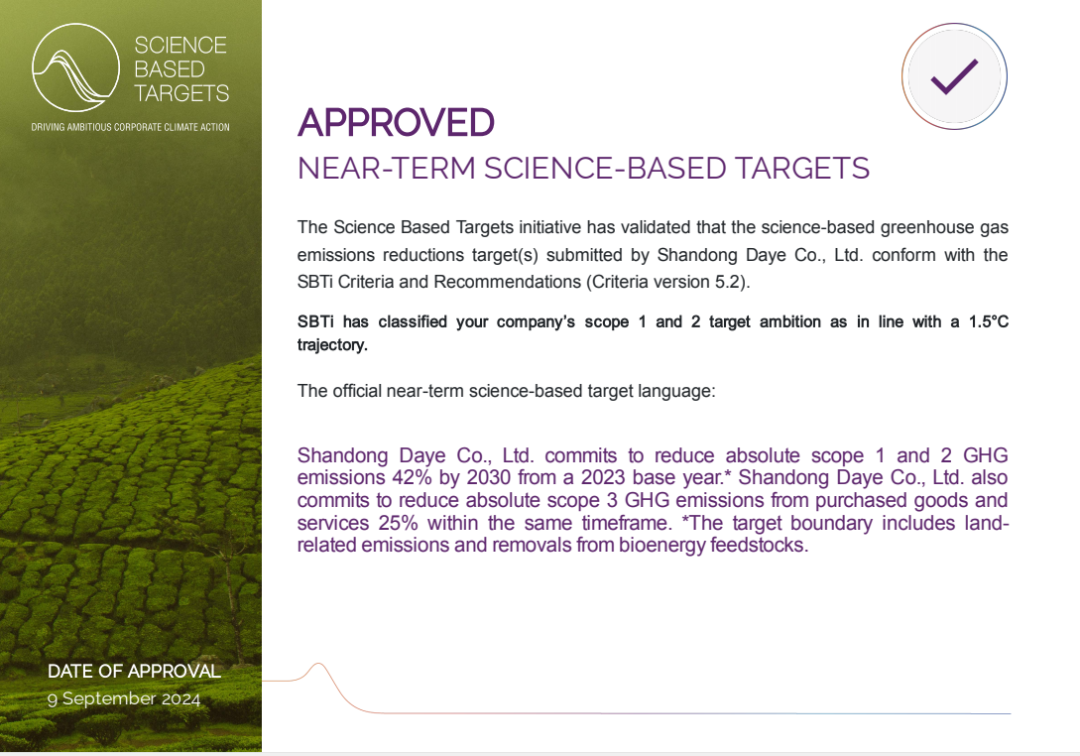
SBTi is a global initiative jointly launched by the World Wildlife Fund (WWF), the Center for Global Environmental Information (CDP), the World Resources Institute (WRI), and the United Nations Global Compact Project (UNGC) in 2015. The initiative provides specific resources and practical guidance for different industries, aiming to help businesses set greenhouse gas emission reduction targets that comply with climate science and the requirements of the Paris Agreement.
In the context of intensified global climate change, companies not only need to fulfill their social responsibilities, but also need to take concrete actions to reduce carbon emissions. As a leading enterprise in the industry, Daye Group has always been committed to reducing its own operational and supply chain carbon emissions. Through conducting comprehensive carbon screening work covering areas one, two, and three within the company, it not only grasps its own carbon emissions situation, but also scientifically formulates comprehensive energy-saving and emission reduction measures from multiple perspectives, firmly adhering to the path of low-carbon and sustainable development.
In the future, Daye Group will focus on scientific carbon targets, adhere to ecological priority, actively respond to national policies on green circular economy and the United Nations' sustainable development goals, regularly disclose progress made in addressing climate change and energy conservation and emission reduction, and work together with suppliers to contribute to the sustainable development of the earth to the best of our ability.